






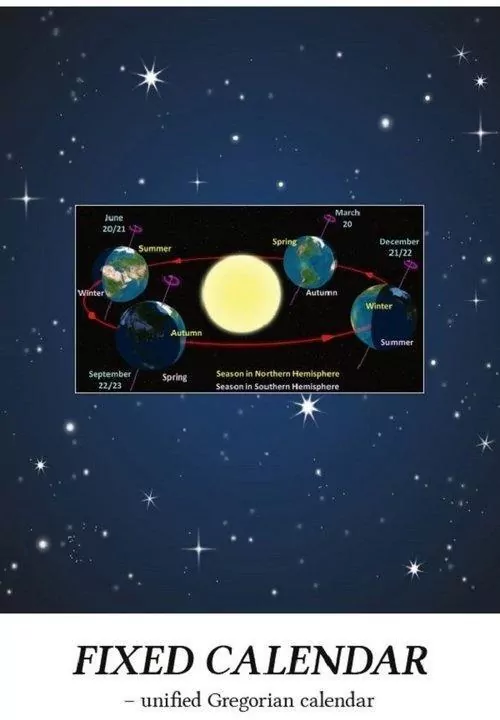

Fixed Calendar unified Gregorian calendar

The calendar we use today is basically the Julian calendar introduced in 45 BC by Julius Caesar. In 1582 Pope Gregory XIII made only a minor amendment to this calendar concerning leap years in order to prevent the calendar from lagging behind the solar year by 1 day in every 128 years minimising this error to 1 day in every 3322 years. When it was first created, there were only two versions of theCzytaj więcej

  • Wydawnictwo: Bookplan.pl
  • Okładka: miękka
  • Liczba stron: 28
  • Wymiary: 212 x 145
więcej parametrów
Polecamy podobne produkty
Zobacz wszystkie

O książce

The calendar we use today is basically the Julian calendar introduced in 45 BC by Julius Caesar. In 1582 Pope Gregory XIII made only a minor amendment to this calendar concerning leap years in order to prevent the calendar from lagging behind the solar year by 1 day in every 128 years minimising this error to 1 day in every 3322 years. When it was first created, there were only two versions of the Julian calendar. Th e first was the ordinary year calendar and the second was the leap year calendar. Th e division of the calendar into weeks increased the number of versions from two to fourteen, and the introduction of a moveable Easter meant that since 325 AD we have been using a calendar in as many as 490 versions each year the calendar brings us a different arrangement of weeks and holidays, a different number of working and non-working days. Th e industrial age created the need for sorting out the excessive diversity prevailing in many areas. A new fi eld was developed standardisation which includes, among other things, unification, that is reducing issues to a single form or standard. In 1834, Marco Mastrofi ni (1763-1845), an Italian priest, philosopher and mathematician, proposed the unification of the calendar and the introduction of a fixed calendar. Half a century later, the French Astronomical Society organised a special competition to create a new, fixed calendar. A number of other proposals were also put forward before World War One. Enthusiasts of reforming the calendar managed to get the International Congress of Chambers of Commerce to pass a resolution in support of the reform, while the Swiss government pledged to take appropriate diplomatic action. In the turbulent 20th century, the issue of calendar reform was not forgotten just postponed until calmer times. We are now in the third decade of the 21st century and there is nothing to suggest that calmer times are ever to come. It is high time to seriously address the issue of introducing a fixed calendar theunifi ed Gregorian calendar.

Dane szczegółowe

Identyfikator produktu
3536334
Tytuł
Fixed Calendar unified Gregorian calendar
Wydawnictwo
Język
angielski
Język oryginału
polski
Liczba stron
28
Typ okładki
miękka
Rok wydania
2024
Wymiary
212 x 145
Waga
0.05 kg
Wysokość
145 mm
Długość
212 mm
Nasza cena
12,89 zł
Bądź pierwszy!
Twoja recenzja produktu “Fixed Calendar unified Gregorian calendar” będzie bardzo przydatna dla innych użytkowników.
Recenzje produktów są zarządzane przez stronę trzecią w celu weryfikacji autentyczności i zgodności z naszymi wytycznymi dotyczącymi ocen i recenzji
Recenzje
Każdą z recenzji weryfikujemy na trzy sposoby:
  • Klient zweryfikowany
    Autorzy recenzji z tym oznaczeniem są naszymi klientami. Kupili ten produkt w sklepie tantis.pl.
  • Klient niezweryfikowany
    Autorzy recenzji z tym oznaczeniem są naszymi użytkownikami, ale nie możemy potwierdzić, że kupili ten produkt w sklepie tantis.pl.
  • Recenzja Zweryfikowana
    Potwierdzamy, że prezentowana opinia może dotyczyć danego produktu i zawiera elementy jego recenzji.
Dostawa i płatność
Udostępnij produkt
Wstaw link na:
lub skopiuj link
Dodano do koszyka